Free Kindle Edition of "The Perfect Speculator"

Around this time last year, I stumbled upon a trading book called The Perfect Speculator.   An almost unheard of book, it ended up becoming one of my top ten all time favourites.

The book, in my opinion, captures the essence of what it takes to become a professional stock market speculator.

The reason I mentioned this book now is because, for whatever reason, the author has decided to sell the Kindle version of the book for free.   You can click on the picture below if interested:


Commodity Currencies Trend Down

The trend following system that I use has generated some new signals, which I think are beginning to form a common theme:  commodities and commodity currencies are weakening.

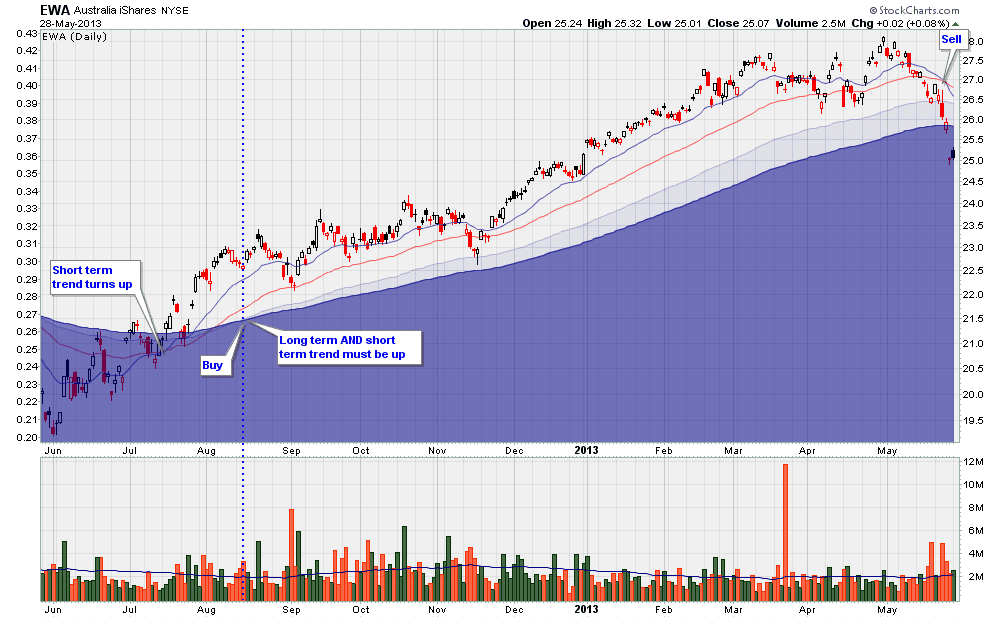
A new signal was generated for the Australia iShares ETF, ticker symbol EWA:


The chart above shows the short term trend changing, as the 20 and 50 day moving averages cross.   It's pre-mature to short this market though, as the long term trend remains up.   

Everything else being equal, this ETF will lose value if the Australian Dollar falls and, in fact, the Aussie as fallen about 7% this month, as the following monthly chart shows:


Similarly, the Canadian dollar is also weak.   The next chart shows the Loonie entering a bearish long term down trend:


Because the long term trend has turned down and since the short term trend is also down (not shown), the Canadian Dollar is on a mechanical sell signal for me.   This alone would be reason enough to short the currency (which I am).  

But that's not all.   The next chart shows a weekly chart of price action breaking down to a new low:


Even if you have no interest in these two currencies, I think the price action carries broader implications:  money is leaving the commodities sector. 

Trading with more Signal and Less Noise

The S&P 500 declined this week, but the trend remains up and no technical damage has occurred.

One mistake that I used to make in the markets was to over-react to day to day fluctuations while forgetting about the longer term trend.  Now, however, I know that any one day fluctuation in the market is essentially just noise.

Below is a chart of the S&P 500 with all of the day to day price movements stripped away, leaving just the moving averages visible:


The way I see it, by smoothing out price in the the form of moving averages, what we end up with is more signal and less noise.   By reducing my exit strategy to one variable, my job is easy: to continue buying and holding strong stocks for as long as the trend persists.

Speaking of strong stocks, here is a chart of a stock that I bought this week:


The stock above recently made a new all time high after consolidating for the last 6 months.  That combined with what is, subjectively, a favourable chart pattern, made this stock a buy for me.

Trend Changes for the Dow/Gold Ratio

Last weekend,  I posted some charts showing gold's collapse and also of US stocks making new highs. Interestingly, when you graph both gold and US stocks as a ratio, what you get is a major long term trend change.

The chart below shows the Dow Jones versus Gold going all the way back to 1980:


If the chart above is rising, then that means that stocks are outperforming gold.  And that was the case during the great bull market lasting from the early 1980's to around the year 2000.   The way I see it, this was a time of real prosperity in America.

If the chart above is falling, then that means gold is outperforming stocks, which has been the case from the year 2000 to this moment of time, right now.   Arguably, this was a time of phoney growth and a bubble economy, and certainly a lost decade for stocks.

The reason I post this chart now is that it appears that the ratio is in the beginning stages of a major change of trend, as evidenced by the breaking of a downward sloping trend line.    Hypothetically, if the ratio rose to 20, then that could mean $1,000 for an ounce of gold and Dow 20,000.  

While it is not my intention to make any predictions, I do think that, objectively, stocks are in a major bull market, while precious metals are currently in a bear market.

Rumours of Trend Following's Death are Greatly Exaggerated

Last October when trend following giant, John Henry, decided to close up shop, there were rumours circulating that perhaps trend following as a strategy was dead.

I distinctly remember corresponding with another trend following trader, from England, saying that if I had to guess, this event may act as a contrarian signal that would lead to large gains for trend followers, similar to 2008.

And since last November, there are have indeed been some truly extraordinary trends in a wide variety of markets.   Using my quadruple moving average system,  the foundation of all of my charts, would have generated some clear, objective and profitable trading signals.    Below are a few examples:


The chart above shows the Russell 2000.  A buy signal was generated near the beginning of December and, since then, the index has blasted higher, much to the frustration and embarrassment of the vast majority of other bloggers out there who have tried to call a top in this market.

The great thing about being a top picker is that you will always end up being right, eventually. The downside, however, is that tend they to lose money over the long run, which is likely why they have to resort to selling newsletters, or cover their website with annoying ads,  whereas trend following traders just tend to trade, in silence.


Next, we have a chart of the Japanese Yen.  A black and white, unambiguous, objective sell signal was generated in mid-October.


Thirdly, a sell signal was generated in gold near the beginning of December.   Since then, gold was simply not buyable for me and I have forgotten about the metal, deploying my capital in more productive areas.


To the chagrin of gold bugs, "doomers", and perma-bears, precious metals stocks have completely collapsed, with junior gold stocks down 73% since the top.   Meanwhile, a trend following trader could have exited the market in an objective, emotionless manner before any serious damage occurred.